

Page Map Placeholder Cards
A considered system for designing pages with clarity, consistency, and intent
Design before placement. Structure before story

There’s a quiet frustration many memory keepers carry.
You have the photographs.
You have the stories.
You have a sense of style that is distinctly your own.
And yet, some pages settle beautifully, while others never quite resolve.
That tension is rarely about creativity. It is about structure.
Pagemap Placeholder Cards were created to resolve that, quietly, deliberately, and with precision.

The Problem No One Names
Most digital memory keeping begins with a blank page and good intention.
From there, you are asked to make a sequence of design decisions in real time:
placement
scale
hierarchy
balance
flow
Individually, each is manageable. Together, they introduce friction.
So you adjust.
You move things until they feel right.
You second-guess.
You rework as you go.
You eventually settle.
Not from lack of care, but from lack of framework.

Why This System Exists
Pagemap Cards were never designed as decoration.
They are infrastructure.
A way to remove unnecessary decision-making, establish hierarchy before content, and create layouts that are both repeatable and refined.
They offer something most memory keepers have never been given:
A clear, usable method.

What the Cards Do
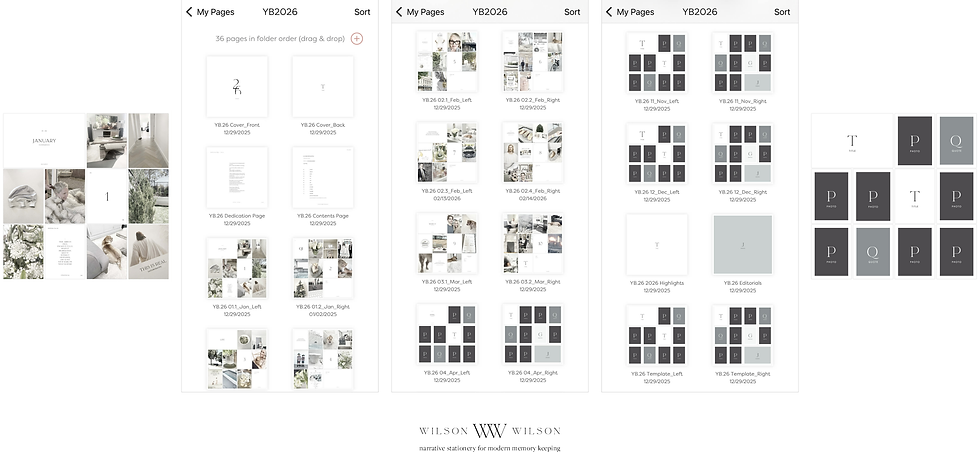
Each card holds a defined role within the page:
P: Photo
Establishes where imagery sits, and how it carries visual weight
J: Journal
Holds space for narrative, so words are never an afterthought
Q: Quote
Introduces emphasis, reflection, or a distilled line of meaning
T: Title
Anchors hierarchy and orients the viewer
G: Graphic |Space
Creates breathing room, ensuring clarity rather than congestion
Together, they form a pagemap, a resolved structure before content is ever introduced.
They are not designed to be seen.They are designed to ensure the page works.

The Method
This is where the shift happens, from arranging to designing.
Begin without content
Open your page and place your Pagemap Cards first.No photographs. No text.
This single step removes reactive design.You are no longer responding, you are directing.
Establish hierarchy early
Decide what leads. One element must carry weight.Everything else supports it.
If everything is equal, nothing holds.
Design the reading experience
A page is not a collection, it is a sequence.
Consider the movement:
Where does the eye begin?
Where does it travel?
Where does it rest?
You are shaping how the page is read.
Commit to the structure
This is where discipline matters.
Resolve the layout fully with placeholders, then honour it.
Avoid adjusting once content is introduced.
Replace with precision
Now, simply place:
Photos into P
Journalling into J
Quotes into Q
Titles into T
No resizing. No repositioning.
You are no longer designing, you are placing.
Refine, don’t rebuild
Final adjustments remain subtle: alignment, spacing, typographic scale.
If something feels unresolved, return to the structure.

What Changes
This system does more than improve pages, it reshapes the experience entirely.
You remove decision fatigue.
Your work becomes cohesive.
Your stories carry greater presence.
You move with clarity and confidence.
You create efficiently, without losing depth.

From Pages to System
One resolved layout becomes a foundation.
A reusable template.
A repeatable rhythm.
A recognisable style.
Over time, you build a library of structures.
And the question shifts.
From:
How do I design this page?
To:
Which structure best honours this moment?
That is the shift into a considered, professional approach.

A Note on Restraint
More does not strengthen a page.
More photographs do not create meaning.
More words do not deepen a story.
More embellishment does not bring clarity.
Restraint does.
The G [Graphic|Space] cards exist to protect the page from noise.
Use them with intention.
What This Allows
You document consistently, without burnout.
You create albums that feel calm, intentional, and resolved.
You honour both imagery and narrative with equal weight.
You develop a signature style, without forcing one.
Most importantly, you remain present in the memory, rather than lost in the making.
Final Thought
You do not need more tools.
You need a way of working that begins with clarity, holds structure, and finishes with confidence.
Page Map Placeholder Cards offer exactly that.
A disciplined, elegant system, that elevates not only how your pages look,but how your memories are preserved, understood, and returned to.

Comments